
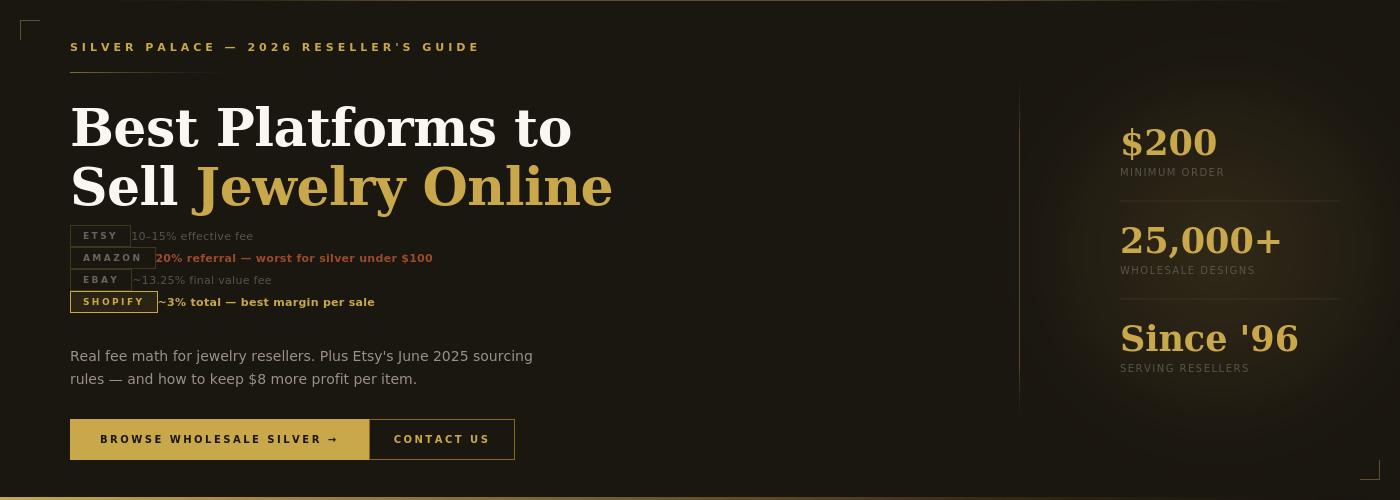
Best Platforms to Sell Jewelry Online
Best Platforms to Sell Jewelry Online
For jewelry resellers, Shopify and Etsy offer the best combination of reach and economics — but which one comes out ahead depends on your monthly volume and how much margin you can afford to give a platform on every sale.
Most "best platform to sell jewelry" guides are written for makers — artisans who hand-craft pieces and need a place to tell their story. If you're a reseller sourcing wholesale jewelry and listing it for profit, you have a different problem. Your cost of goods is already locked in. Your margin lives or dies on what the platform takes.
And on some platforms, what they take will quietly wreck your numbers on sterling silver pieces priced under $100.
This guide runs the actual math so you can see it clearly before you commit. If you're still putting together your wholesale inventory, start by exploring our wholesale sterling silver jewelry — 25,000+ designs, $200 minimum order, same-day shipping available.
- Amazon charges 20% on jewelry priced under $250 — the highest fee of any major platform, and a serious margin problem for sterling silver in the $20–$80 range
- Etsy's total effective fee averages 10–15% once Offsite Ads kick in; resellers must also disclose items as "sourced" under Etsy's June 2025 policy update
- Shopify keeps roughly 97% of every sale but brings zero built-in traffic — you need to drive buyers yourself
- A $45 sterling silver chain earns you about $8 more profit on Shopify than on Amazon — per item, per sale, every time
- The strongest long-term strategy pairs Shopify (brand ownership) with Etsy or eBay (discovery) to reduce platform dependence over time
Why Resellers Face a Different Platform Decision
When a handmade jewelry maker lists on Etsy, they bring a story: the artist, the process, the one-of-a-kind nature of the work. Resellers work differently. You're buying 925 Sterling Silver chains, Italian chains, or Hip Hop Jewelry at wholesale prices and reselling at a markup. Your profit comes from volume, smart sourcing, and keeping overhead low.
- Platform fees hit harder. Makers sometimes have near-zero material costs and can absorb a 15–20% platform cut. You already paid for the product — every fee comes straight out of your take-home.
- Platform rules can work against you. Amazon Handmade requires artisan verification most resellers can't pass. Etsy's June 2025 policy requires the "sourced" label, which affects search visibility.
- Volume changes everything. A reseller moving 200 pieces a month at $40 average needs low per-unit costs far more than low monthly fees. The math scales fast, in either direction.
E-Commerce Platform Fee Comparison at a Glance
| Platform | Listing Fee | Transaction / Referral Fee | Payment Processing | Monthly Cost |
|---|---|---|---|---|
| Etsy | $0.20/listing (4-mo) | 6.5% of sale | 3% + $0.25 | $0–$10 (Plus, optional) |
| Amazon | Free | 20% on first $250 / 5% above $250 | Included | $39.99/mo (Professional) |
| eBay | $0.35 (after 250 free/mo) | ~13.25% final value fee | $0.30/order | $0–$35/mo (optional store) |
| Shopify | None | 0% (with Shopify Payments) | 2.9% + $0.30 | $39–$399/mo |
| WooCommerce | None | 0% | ~2.9% (payment gateway) | ~$4–22/mo (hosting) |
| Poshmark | None | 20% on sales $15+ ($2.95 flat under $15) | Included | None |
| BigCommerce | None | 0% | Payment gateway fees | $29–$299/mo |
Two things worth flagging: Amazon's tiered jewelry fee looks almost friendly at the high end — but for sterling silver pieces priced $20–$80, you're paying the full 20% every time. The 5% tier only kicks in on the portion of the price above $250. A $45 chain costs you $9 in Amazon referral fees alone, before any other costs.
Etsy's 6.5% transaction fee looks reasonable until Offsite Ads activate. Once your shop clears $10,000 in annual revenue, Etsy automatically enrolls you in Offsite Ads and charges 12–15% on any sale that comes through an ad click. You can't opt out. On those ad-attributed sales, your total effective fee can hit 20% or higher.
The Real Margin Math: What You Actually Keep Per Sale
Percentages are easier to compare when you see them as dollars. Here's what a reseller actually takes home on a $45 sterling silver chain — wholesale cost $15, retail price $45:
| Platform | Total Fees | Net Revenue | Profit After $15 Cost | Margin |
|---|---|---|---|---|
| WooCommerce | ~$1.61 | $43.39 | $28.39 | 63.1% |
| Shopify | ~$1.91 | $43.09 | $28.09 | 62.4% |
| Etsy | ~$4.78 | $40.22 | $25.22 | 56.1% |
| eBay | ~$6.26 | $38.74 | $23.74 | 52.8% |
| Poshmark | $9.00 | $36.00 | $21.00 | 46.7% |
| Amazon | ~$9.99 | $35.01 | $20.01 | 44.5% |
The $8 gap between Shopify and Amazon looks small on paper. Scale it to 200 sales per month and that's $1,600 in additional monthly profit — or roughly $19,200 a year. The trade-off is real though: Shopify and WooCommerce only beat the marketplaces if you can drive equivalent traffic yourself.
Starting with a smaller wholesale order to test a new platform makes sense. At Silver Palace, you can place an order for as little as $200 — enough to run a real test on a new channel before you commit to volume.
Contact Us to Place a Test Order →Platform-by-Platform Breakdown
Etsy: Best for Discovery, Riskiest for Resellers
- 96 million active buyers, 445 million monthly visits
- Low barrier to entry; listings live in minutes
- Strong algorithm for consistent inventory updates
- Mobile-first shopping experience built for impulse purchases
- Offsite Ads (12–15%) activate at $10K/year — can't disable
- Algorithm outages have caused multi-week traffic drops
- No customer ownership — Etsy controls the buyer relationship
- June 2025 sourcing rules require "handpicked by seller" label
Amazon: Biggest Reach, Worst Math for Silver
- Largest single customer base of any platform
- FBA removes shipping and storage burden
- Prime badge builds buyer trust and speeds purchase decisions
- 20% referral fee on items priced under $250
- Chinese factories list identical styles at prices you can't match
- Amazon displays competitor products on your listing page
- Account suspension risk is significant; recovery takes weeks
- FBA adds $3–$8+ fulfillment fees per item on top of referral fee
On Amazon Handmade: The 15% referral fee sounds appealing, but Amazon Handmade requires artisan verification. Wholesale resellers of factory-sourced jewelry do not qualify.
eBay: Easy Entry, Mid-Range Fees
- No sourcing restrictions — resellers explicitly welcome
- Auction format creates price discovery on bold, unique pieces
- Strong buyer intent for hip hop chains, sterling silver bangles
- 134 million active buyers
- Default sort surfaces cheapest listings first — race to the bottom
- Buyer protection heavily favors buyers; disputes more common
- Less visual and brand-forward than Etsy
Shopify: Best Margins, No Built-In Traffic
- Lowest ongoing fees of any major platform
- Full brand control: custom domain, email list, retargeting
- Native integrations with Google Shopping, Instagram, TikTok, Pinterest
- B2B wholesale pricing tiers available via apps
- You must build every visitor yourself — SEO, ads, social content
- $39–$399/month plan runs regardless of sales
- Setup takes a few days; more initial investment than a marketplace
The breakeven between Shopify and Etsy happens at roughly $1,350 in monthly revenue — after that, Shopify's lower fees save you more than its plan costs.
Other Platforms Worth Considering
- WooCommerce: Free software, full ownership, lowest possible fee structure. Requires WordPress know-how. Right for tech-comfortable resellers who want maximum SEO control.
- Poshmark: Strong community and zero listing fees, but 20% commission on sales over $15 makes it one of the worst platforms for margin on wholesale jewelry. Better as a clearance channel.
- BigCommerce: Worth exploring if building a hybrid B2B and retail operation. Wholesale pricing tiers and multi-channel inventory sync are built in without extra apps.
Etsy's 2025 Sourcing Rules: What Every Reseller Must Know
In June 2025, Etsy updated its Creativity Standards and now requires every seller to disclose one of four item classifications on every listing.
Four Required Item Classifications
If you're reselling wholesale jewelry — from Silver Palace or any other supplier — your listings fall under "handpicked by seller." Incorrect labeling can trigger listing removal. Per Etsy's seller handbook, full compliance is required as of June 2025 for all active listings.
- Update all existing listings with the correct "handpicked by seller" designation — incorrect labeling can trigger listing removal
- Write shop descriptions that lean into the value you actually provide: consistent inventory, fast shipping, curated selection
- Monitor Etsy's seller handbook for further algorithm documentation on sourced inventory
Building a Multi-Platform Strategy
The most resilient jewelry resellers don't put everything on one platform. A practical approach that works well for wholesale silver inventory:
Build early sales and product validation without needing to drive your own traffic. Learn what converts before you invest in your own channel.
Use it as your home base — branded URL, email capture, loyalty offers. Even with low volume early on, you're building the infrastructure you'll need.
Post-purchase inserts, follow-up emails, and a modest loyalty discount are enough to shift a meaningful share of repeat orders to your owned channel — where you keep $8 more per item.
Build organic and paid traffic as you grow. This approach hedges platform risk — if Etsy's algorithm changes or eBay tightens category fees, your business doesn't collapse.
Which Platform Is Right for You?
| Your Situation | Best Starting Platform |
|---|---|
| New reseller, no existing audience | Etsy |
| Moving volume fast on hip hop or fashion styles | eBay + Etsy |
| Have a social following or email list already | Shopify first |
| Building a long-term brand with SEO | Shopify or WooCommerce |
| Selling both retail and wholesale | BigCommerce |
| Testing a new product category at low volume | Etsy or eBay |
One note on the Shopify monthly fee: the $39 plan feels like overhead when you're starting out. But at just 20 sales per month at $40 average, the fee savings over Amazon cover the plan cost and then some. And at 100 sales per month, Shopify is saving you meaningful money compared to every marketplace on this list.
Frequently Asked Questions
Yes — but under Etsy's June 2025 Creativity Standards, you must label your listings as "handpicked by seller." You can still sell wholesale inventory on Etsy; you cannot market it as handmade or imply you made the pieces yourself. The "handpicked" designation may affect your organic search visibility as Etsy continues refining its algorithm around item types.
Amazon charges 20% on the portion of a jewelry item's sale price up to $250, and 5% on anything above $250. The minimum referral fee is $2.00 per item. Add the $39.99/month Professional plan fee, and for most sterling silver pieces priced under $100, you're giving up roughly 20–22% of the sale price before any other costs. See the full category fee table at Amazon Seller Central.
Not if you have no existing audience or marketing plan. Shopify's fee advantages only show up when you're actually generating sales — and without built-in traffic, that takes time. The common path: start on Etsy or eBay to build early revenue, then launch Shopify once you have customers to migrate and a clearer sense of what's selling.
WooCommerce has the lowest ongoing fees — hosting costs and payment processing only, with no transaction fees. Shopify is the cheapest major hosted platform once you factor in per-sale costs. Etsy is the cheapest way to reach buyers if you have no existing audience, since you're paying for access to 96 million active shoppers without running a single ad.
Yes, and for most serious resellers, you should. Tools like Sellbrite, Linnworks, or Shopify's built-in multichannel features let you sync inventory across Etsy, eBay, Shopify, and Amazon from a single dashboard. The key is syncing inventory accurately so you don't oversell.
The Bottom Line
No single platform is the right answer for every jewelry reseller. Etsy gives you buyers on day one but charges more as you grow. Amazon has the largest customer base but the highest fees — a real problem for wholesale hip hop jewelry and sterling silver pieces in the $20–$80 range. Shopify keeps the most money per sale but requires you to build your own traffic.
The smartest approach: start where buyers already are, understand what each platform actually costs you per sale, and build toward owning your customer relationships on a branded store over time.
Whatever platform you choose, you need inventory worth listing. Silver Palace has over 25,000 wholesale jewelry designs — 925 Sterling Silver, 14K Gold, moissanite, lab-grown diamonds, Italian chains, and Hip Hop Jewelry — all in ready stock and available for same-day shipping.