
Flat Chain vs Regular Chain: Weight, Cost & Margin Guide
Flat Chain vs Regular Chain: Weight, Cost & Margin Guide
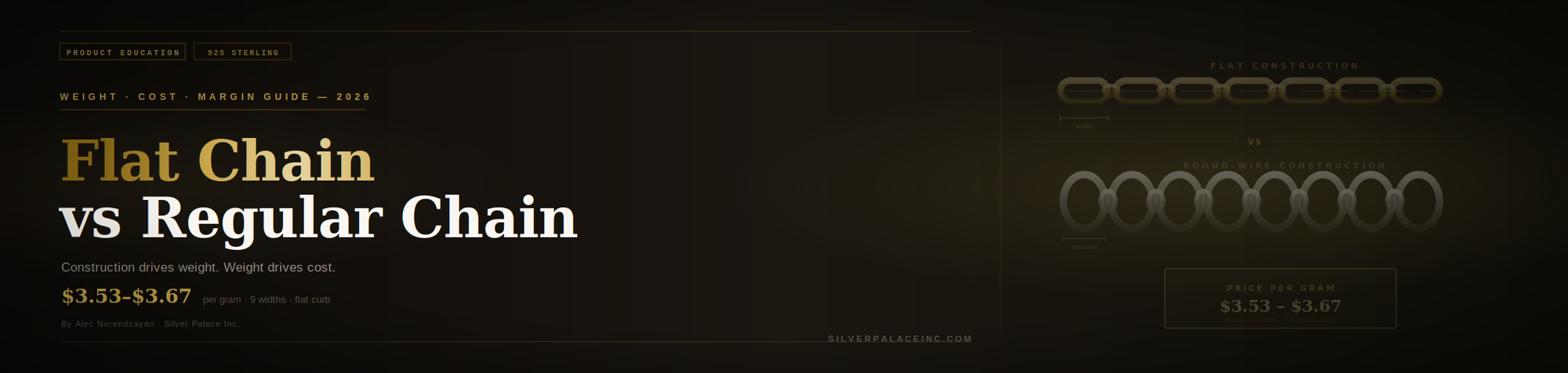
Flat construction usually runs heavier than round wire — not lighter. Here's what the real weight data shows, and what it means for your margin.
A flat chain and a regular, round-wire chain don't weigh the same at a matching nominal width — and it's not in the direction most buyers assume. Based on published weight specs for standard round-wire curb and figaro chains compared against our own super flat catalog, a standard round-wire chain typically weighs less than a flat, pressed chain at a comparable width. Pressing a link flat and wide takes a heavier starting wire than drawing a round link to that same nominal width — so "flat" isn't the lighter, cheaper option. It's usually the more substantial one.
Here's the number that should catch a wholesale buyer's attention: across our entire super flat curb and figaro lineup — from the thinnest width to the thickest — price per gram barely moves. It holds inside a $3.53 to $3.67 band no matter which width you order. If you've ever assumed a "flat" chain costs less than a "regular" one at the same width, or wondered how to plan margin across a width ladder without guessing, here's what the real numbers show.
- Published weight specs for standard round-wire curb and figaro chains show they typically weigh less than a comparably-sized flat, pressed chain — flat construction usually takes more metal to reach a given width, not less
- Across our full super flat curb and figaro range, price per gram holds in a tight $3.53–$3.67 band regardless of width — cost scales predictably with weight
- At the exact same width and length (3.8mm, 18"), our super flat curb chain runs about 26% lighter than a comparable flat curb chain published by another jewelry-chain supplier — our construction is efficient within its category
- We stock curb and figaro chains exclusively in flat construction — there's no separate round-wire version in our catalog to compare side by side
- Predictable price per gram means predictable margin: pick a width, know the cost, set your markup with no surprises
Curious how the numbers break down by width? Browse the Super Flat Curb Chains collection to see current widths, weights, and pricing.
Browse Super Flat Curb Chains →What Makes a Chain "Flat" vs. "Standard"?
A standard, round-wire chain keeps a rounder cross-section link to link — its wire diameter essentially is its width. A flat chain — sometimes called pressed, beveled, or super flat — takes a link and presses it wider and thinner so it lies smoother against the skin and catches more light. Both are built from genuine .925 sterling silver, and both go through the same basic twist-and-link process — the difference is entirely in that final pressing step.
Chain constructions are generally grouped by link shape and wire profile first, with "flat" and "round" as two different profiles applied to a style like curb — not two different styles entirely. We stock curb and figaro chains exclusively in the flat profile. Every width and finish we carry in these two styles is built the same way. That's a deliberate sourcing choice, not a missing option, and the rest of this guide explains why — using published weight specs for standard round-wire chains as a real reference point.
Flat Chain vs Regular Chain: What the Real Weight Data Shows
Regular (Round-Wire) Chains vs. Our Super Flat Chains
We don't stock a round-wire curb or figaro chain ourselves, so we can't weigh one against ours directly. What we can do is compare our real catalog data against published weight specifications for standard round-wire chains — sourced from independent jewelry-chain catalogs rather than a single retailer's marketing copy:
| Chain | Construction | Width | Length | Weight | Source |
|---|---|---|---|---|---|
| Regular curb (reference) | Round wire | 1mm | 16" | ~1.6g | Published specs, two independent chain suppliers |
| Super Flat Curb (ours) | Flat, pressed | 1.8mm | 16" | 3.57g | Our catalog |
| Regular figaro (reference) | Round wire | 3.1–4mm | 18" | 6.94g | Published specs |
| Super Flat Figaro (ours) | Flat, pressed | 3.9mm | 18" | 8.1g | Our catalog |
| Another supplier's flat curb (reference) | Flat, pressed | 3.8mm | 18" | 11g | Published specs |
| Super Flat Curb (ours) | Flat, pressed | 3.8mm | 18" | 8.085g | Our catalog |
The widths in the first two comparisons aren't a perfect match. Treat those rows as directional, not a precise percentage. The last comparison is the useful one: at the identical width and length (3.8mm, 18"), ours vs. another supplier's flat curb chain — ours runs about 26% lighter. Two things are true at once: flat construction generally takes more metal than round wire to reach a given width, and within the flat category, our construction is meaningfully more metal-efficient than at least one other published flat-chain spec at the same size.
See the difference for yourself — browse current widths and weights in both collections.
Super Flat Curb Chains → Super Flat Figaro Chains →Why Flat Chains Usually Weigh More — and Why That's Not a Quality Cut
Pressing a link flat and wide doesn't remove metal — it needs more of it to start. A round wire drawn to a given diameter is already at its finished width, but a flat link has to be pressed and spread from a thicker starting wire to hold its shape at that same nominal width without looking thin or flimsy. That's why the flat versions of a style typically run heavier than the round-wire version at a matching width — it's a structural requirement of the profile, not a manufacturing shortcut.
A Related Technique: Hollow vs. Solid Chains
Flattening isn't the only construction choice that affects how much metal is in a chain. Hollow construction does the opposite: instead of using more metal to hold a wide, pressed shape, it builds a chain with a thin outer wall and an empty core — so less metal goes into a chain that still looks full-sized. Both are legitimate, widely used techniques; they just move metal content in opposite directions depending on the look a style is going for.
What Our Own Weight & Price Data Shows
Pulled directly from our current catalog — single piece, 16-inch length, basic non-plated finish:
Super Flat Curb Chain| Width | Weight | Price | Price / gram |
|---|---|---|---|
| 1.8mm | 3.57g | $13.11 | $3.67 |
| 2.1mm | 4.305g | $15.74 | $3.66 |
| 2.8mm | 4.8g | $17.20 | $3.58 |
| 3.8mm | 8.211g | $29.15 | $3.55 |
| 4.7mm | 9.765g | $34.48 | $3.53 |
| 5.2mm | 11.655g | $41.15 | $3.53 |
| 6.1mm | 17.43g | $61.88 | $3.55 |
| 7.2mm | 21.945g | $77.91 | $3.55 |
| 7.9mm | 27.1g | $96.21 | $3.55 |
| Width | Weight | Price | Price / gram |
|---|---|---|---|
| 1.7mm | 2.94g | $10.64 | $3.62 |
| 2.1mm | 3.549g | $12.97 | $3.65 |
| 2.9mm | 4.515g | $16.18 | $3.58 |
| 3.9mm | 6.825g | $24.22 | $3.55 |
| 5mm | 8.6g | $30.64 | $3.56 |
| 5.6mm | 13.02g | $45.97 | $3.53 |
| 6.8mm | 16.695g | $59.27 | $3.55 |
| 7.8mm | 19.53g | $69.34 | $3.55 |
| 8.9mm | 24.78g | $87.50 | $3.53 |
Notice what doesn't change much: price per gram. From the thinnest width to the thickest, both styles stay inside a roughly 15-cent band. Because sterling silver is priced largely by its weight in pure silver content, that consistency isn't a coincidence — it's what you'd expect when cost is driven by weight and weight scales predictably with width for a given construction.
Want current stock and pricing on every width we carry? Browse the full catalog of wholesale sterling silver chains.
Browse Wholesale Silver Chains →What This Means for Your Margin
A flat, predictable price-per-gram is genuinely useful for a wholesale buyer building a price ladder. You don't need to reprice your whole case every time you add a new width — you need to know roughly where cost lands per gram, apply your markup, and adjust for the actual weight of the width you're stocking.
That predictability also makes it easier to test a wider width range without overcommitting. If you know a 5.2mm curb chain will land close to $3.53 a gram before you even check the price, you can decide whether it fits your case before you place the order — not after.
- Find the closest width to the one you're considering in the tables above and note its price per gram.
- Multiply that figure by the approximate weight of the width you're pricing (check the product page — weight scales with width, not linearly, so don't guess).
- Apply your standard markup on top of that estimated cost.
- Confirm against the live product page before finalizing — prices shift slightly with the silver market; the per-gram rate is a planning tool, not a locked quote.
This won't replace checking the actual listing, but it's enough to rule a width in or out before you spend time digging through it.
Frequently Asked Questions
The Bottom Line
The flat chain vs regular chain question isn't a quality tier apart — it's a construction choice, and that choice shows up directly in what a chain weighs and what it costs.
- Published specs for standard round-wire curb and figaro chains typically run lighter than a comparably-sized flat chain — flat construction usually needs more starting metal to hold its pressed shape at a given width
- Our super flat curb and figaro pricing holds inside a $3.53–$3.67 per gram band across every width we carry — cost within our line stays predictable regardless of that broader flat-vs-round pattern
- At the one width we could compare directly against another supplier's flat curb chain (3.8mm, 18"), ours ran about 26% lighter — our construction is efficient within its own category, even if flat construction overall runs heavier than round wire
- That consistency makes margin planning genuinely easier — know the width, estimate the weight, apply your markup
Whether you're pricing your first width or your fifteenth, the same math applies: weight drives cost, and construction drives weight.
Phone: (213) 488-9906 | Toll-free: 1-800-686-9949
WhatsApp: 213-716-8471
Email: info@silverpalaceinc.com
Showroom: 640 S. Hill Street, Suites 349, 365 & M28, Los Angeles, CA 90014 — Mon–Fri, 9:30 AM–6:00 PM