
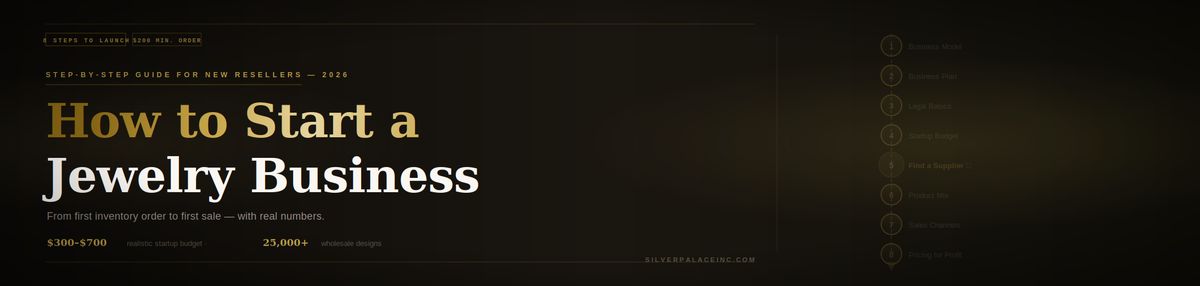
How to Start a Jewelry Business in 2026
How to Start a Jewelry Business
A simple plan, your legal basics, a realistic budget, a supplier you can trust, and a sales channel that matches your customers. Here's how to get all five right.
To start a jewelry business, you need a simple business plan, a legal business structure, a realistic startup budget, a reliable wholesale supplier, and a sales channel that fits your customers. Get those five pieces right, and everything else — marketing, growth, repeat customers — follows from there.
Most guides on this topic stop at "find a good supplier" and leave you guessing about the part that actually makes or breaks a new jewelry business: where your inventory comes from and what it really costs to get started. This guide fills that gap. You'll get a clear, step-by-step path from idea to your first sale, with real numbers instead of vague advice.
- A working jewelry business plan doesn't need to be long — one page covering your niche, customer, supplier, and pricing is enough to start
- A realistic first inventory order runs $200 to $500 — Silver Palace Inc.'s $200 minimum order makes that entry point accessible to nearly any new reseller
- Sourcing wholesale from a US-based direct importer beats overseas platforms for new resellers: no customs delays, no 100-unit minimums, and same-day shipping from ready stock
- 925 sterling silver is the easiest starting category — widest selection, clearest quality standard, and the strongest resale demand
- The biggest mistake new resellers make isn't underpricing — it's overbuying inventory before they know what actually sells
- Is starting a jewelry business worth it?
- Step 1 — Choose your business model
- Step 2 — Write a simple business plan
- Step 3 — Handle the legal basics
- Step 4 — Budget your startup costs
- Step 5 — Find a wholesale jewelry supplier
- Step 6 — Decide what jewelry to sell
- Step 7 — Set up your sales channels
- Step 8 — Price your jewelry for profit
- Common mistakes new resellers make
- Frequently asked questions
Is Starting a Jewelry Business Worth It?
Jewelry resale is one of the more accessible small businesses to start because the entry cost is low and the demand is steady. You don't need a storefront, a manufacturing background, or six figures in savings.
It works well for three types of people: swap meet and flea market vendors who want fast-moving inventory, boutique owners building a curated in-person collection, and e-commerce sellers running an Etsy, Amazon, or Shopify store. If you fall into one of those groups and you're willing to start small and reinvest, jewelry resale can be worth it.
It's a harder fit if you're looking for a side hustle with zero time commitment. Sourcing, pricing, and customer service still take real hours every week, even at a small scale.
The 8 Steps to Starting a Jewelry Business
Before you buy a single piece of inventory, decide how you'll actually sell it. Your business model shapes everything downstream — from how much cash you need upfront to what kind of jewelry you should stock.
- Swap meet or flea market vendor — Low overhead, cash-based sales, fast-moving statement pieces like hip hop jewelry and Italian chains do well
- Boutique or brick-and-mortar — Higher overhead, but you can carry a curated mix including 14K gold and moissanite for a customer willing to pay more
- Online store (your own site, Etsy, or Amazon) — Lower overhead than a physical shop, but you're competing on photos, descriptions, and shipping speed. Ready stock matters — backorders lose sales fast
- Hybrid — Many resellers start at swap meets or online and add a second channel once they know what sells
None of these is objectively better. Pick the one that matches the customers you already have access to.
A jewelry business plan doesn't need to be 20 pages. Most new resellers who skip this step end up buying inventory they can't sell, because they never defined who they're selling to in the first place.
- Your niche — Fashion jewelry, hip hop chains, fine jewelry, religious pieces, or a mix
- Your customer — Age range, price sensitivity, where they shop
- Your sourcing plan — Which supplier, what minimum order, how often you'll reorder
- Your pricing strategy — Target markup and where your price points land
- Your sales channel — Swap meet, boutique, online, or a combination
Write this down before you spend a dollar. It takes less than an hour and it's the single best filter for whether an inventory decision is actually a good idea.
You don't need a lawyer to start a jewelry business, but you do need a few basic pieces of paperwork in place before wholesalers will sell to you at wholesale prices.
- A business license — usually issued by your city or county
- A resale certificate (also called a seller's permit) — lets you buy inventory without paying sales tax and proves to suppliers you're buying for resale
- An EIN from the IRS — if you're not operating as a sole proprietor under your own name
The Small Business Administration has a straightforward walkthrough of registration requirements by state. Reseller license requirements vary by location — check your state's Department of Revenue for the specific process where you operate.
Here's what it actually costs to get started — with real numbers.
| Cost Category | Realistic Range |
|---|---|
| First inventory order | $200–$500 |
| Business license & resale certificate | $0–$100 (varies by state) |
| Basic packaging (bags, boxes, tags) | $30–$75 |
| Simple website or marketplace listing fees | $0–$50/month |
| Swap meet booth fee (if applicable) | $20–$75/day |
A realistic total to get your first inventory in hand and your first sale made is $300 to $700 — not the thousands some guides imply. That's largely because a wholesale supplier with a $200 minimum order removes the biggest barrier: overseas suppliers often require 100+ units per style just to place an order.
This is the step that determines whether your margins actually work. New resellers usually face three sourcing paths — each with real trade-offs.
- Lowest unit price on paper
- 100+ unit minimums per style
- 4–6 week shipping times
- Customs duties and fees
- No quality inspection before shipment
- Faster shipping than overseas
- Adds markup on top of import price
- You pay more per unit
- Limited direct manufacturer access
- Fewer customization options
- Factory-direct pricing — no middleman markup
- $200 minimum order
- Same-day shipping from ready stock
- 30 years of verified manufacturer relationships
- Walk-in showroom available in LA
When evaluating any supplier, look for a real business address, a samples policy, and a straight answer about quality certifications. If a supplier won't let you order samples or answer questions about hallmarks, that's a red flag worth walking away from.
Silver Palace Inc. is a direct importer based in the LA Jewelry District since 1996, carrying 25,000+ designs with a $200 minimum order and same-day shipping from ready stock.
Browse Our Wholesale Catalog →Your product mix is a margin decision as much as a style decision. Each material category serves a different customer and carries a different price point.
Most new resellers do best starting with one or two categories, learning what actually sells to their specific customers, and expanding from there.
Once you have inventory, you need a place to sell it. Keep your first setup simple.
- Swap meets and flea markets — A table, simple display stands, and a card reader are enough to start
- Online store — A basic Shopify or Etsy shop with clear photos and honest descriptions will outperform a fancy site with no traffic
- Boutique — Focus your floor space on your best-selling categories rather than spreading thin across everything
Don't try to launch on three channels at once. Prove your product mix works on one channel before you add a second.
The standard markup in jewelry resale runs 2.5x to 3x your wholesale cost. A piece you buy for $10 wholesale should retail for $25 to $30. Fashion and hip hop pieces can often support a higher markup, while fine jewelry categories tend to run closer to 2x to 2.5x.
Gross margins in a well-run jewelry resale business typically land between 40% and 60%. Volume discounts from your supplier as you scale can push that even higher — a lower per-unit cost widens your margin on the same retail price.
- Fashion & hip hop jewelry — 3x to 4x wholesale cost typical
- Sterling silver chains & earrings — 2.5x to 3x wholesale cost
- 14K gold & fine jewelry — 2x to 2.5x wholesale cost
- Target gross margin — 40%–60% for a healthy jewelry resale business
Common Mistakes New Jewelry Resellers Make
Frequently Asked Questions
Start Your Jewelry Business on the Right Foundation
Starting a jewelry business comes down to five things: a simple plan, your legal basics, a realistic budget, a supplier you can trust, and a sales channel that matches your customers. Skip the guesswork on any one of those, and the rest gets a lot harder.
The resellers who make it past year one aren't the ones with the biggest first order. They're the ones who started small, tracked what sold, and reinvested in the categories that actually worked.
Phone: (213) 488-9906 | Toll-free: 1-800-686-9949
WhatsApp: 213-716-8471
Email: info@silverpalaceinc.com
Showroom: 640 S. Hill Street, Suites 349, 365 & M28, Los Angeles, CA 90014 — Mon–Fri, 9:30 AM–6:00 PM