
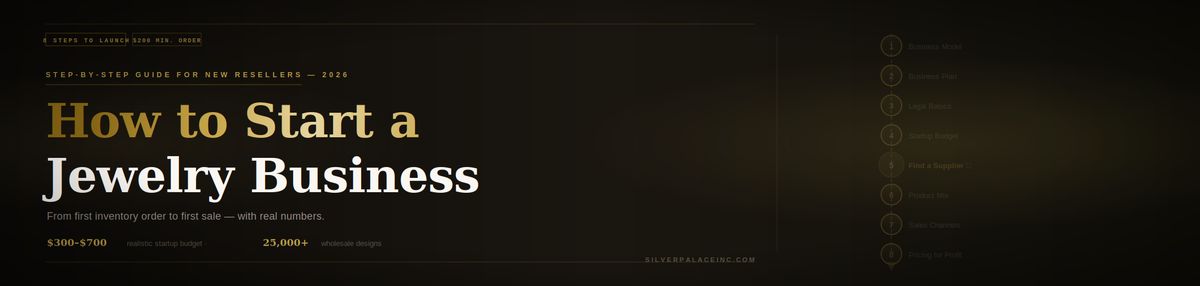
Cómo iniciar un negocio de joyería en 2026
Cómo iniciar un negocio de joyería
Un plan sencillo, tus conceptos legales básicos, un presupuesto realista, un proveedor en quien confiar y un canal de ventas que se adapte a tus clientes. Aquí te explicamos cómo hacer bien estos cinco puntos.
Para iniciar un negocio de joyería, necesitas un plan de negocios sencillo, una estructura legal, un presupuesto inicial realista, un proveedor mayorista confiable y un canal de ventas adecuado para tus clientes. Si logras ejecutar bien estos cinco puntos, todo lo demás —marketing, crecimiento y clientes recurrentes— vendrá por añadidura.
La mayoría de las guías sobre este tema se limitan a "encontrar un buen proveedor" y te dejan adivinando la parte que realmente determina el éxito o fracaso de un nuevo negocio de joyería: de dónde proviene tu inventario y cuánto cuesta realmente empezar. Esta guía llena ese vacío. Obtendrás un camino claro, paso a paso, desde la idea hasta tu primera venta, con números reales en lugar de consejos vagos.
- Un plan de negocios de joyería funcional no tiene por qué ser largo; basta con una página que cubra tu nicho, cliente, proveedor y precios para empezar.
- Un pedido inicial de inventario realista oscila entre $200 y $500; el pedido mínimo de $200 de Silver Palace Inc. hace que ese punto de entrada sea accesible para casi cualquier nuevo revendedor.
- Obtener productos al por mayor de un importador directo con sede en EE. UU. es mejor que usar plataformas extranjeras para nuevos revendedores: sin demoras aduaneras, sin mínimos de 100 unidades y con envío el mismo día desde stock listo.
- La plata esterlina 925 es la categoría inicial más sencilla: la selección más amplia, el estándar de calidad más claro y la demanda de reventa más fuerte.
- El mayor error que cometen los nuevos revendedores no es poner precios bajos, sino comprar inventario en exceso antes de saber qué es lo que realmente se vende.
- ¿Vale la pena iniciar un negocio de joyería?
- Paso 1 — Elige tu modelo de negocio
- Paso 2 — Escribe un plan de negocios sencillo
- Paso 3 — Gestiona los aspectos legales básicos
- Paso 4 — Presupuesta tus costos iniciales
- Paso 5 — Encuentra un proveedor de joyería al por mayor
- Paso 6 — Decide qué joyería vender
- Paso 7 — Configura tus canales de venta
- Paso 8 — Pon precio a tus joyas para obtener ganancias
- Errores comunes que cometen los nuevos revendedores
- Preguntas frecuentes
¿Vale la pena iniciar un negocio de joyería?
La reventa de joyería es uno de los pequeños negocios más accesibles de iniciar porque el costo de entrada es bajo y la demanda es constante. No necesitas un local comercial, experiencia en fabricación ni cientos de miles de dólares en ahorros.
Funciona bien para tres tipos de personas: vendedores de mercados de pulgas y ferias que buscan inventario de alta rotación, propietarios de boutiques que construyen una colección curada en persona y vendedores de comercio electrónico en Etsy, Amazon o Shopify. Si perteneces a uno de estos grupos y estás dispuesto a empezar de a poco y reinvertir, la reventa de joyería puede valer la pena.
Es una opción más difícil si buscas un ingreso extra sin compromiso de tiempo. La búsqueda de proveedores, la fijación de precios y el servicio al cliente requieren horas reales cada semana, incluso a pequeña escala.
Los 8 pasos para iniciar un negocio de joyería
Antes de comprar una sola pieza de inventario, decide cómo la venderás realmente. Tu modelo de negocio define todo lo demás, desde cuánto efectivo necesitas por adelantado hasta qué tipo de joyería debes tener en stock.
- Vendedor de ferias o mercados de pulgas — Bajos gastos operativos, ventas en efectivo; las piezas de impacto como la joyería hip hop y las cadenas italianas se venden bien.
- Boutique o local físico — Gastos generales más altos, pero puedes ofrecer una mezcla curada que incluya oro de 14K y moissanita para un cliente dispuesto a pagar más.
- Tienda en línea (sitio propio, Etsy o Amazon) — Menores gastos generales que una tienda física, pero compites por fotos, descripciones y velocidad de envío. El stock listo es fundamental: los pedidos pendientes provocan la pérdida de ventas rápidamente.
- Híbrido — Muchos revendedores comienzan en ferias o en línea y añaden un segundo canal una vez que saben qué es lo que se vende.
Ninguno de estos modelos es objetivamente mejor. Elige el que coincida con los clientes a los que ya tienes acceso.
Un plan de negocios de joyería no necesita tener 20 páginas. La mayoría de los nuevos revendedores que omiten este paso terminan comprando inventario que no pueden vender porque nunca definieron a quién se lo venden en primer lugar.
- Tu nicho — Joyería de moda, cadenas hip hop, joyería fina, piezas religiosas o una mezcla.
- Tu cliente — Rango de edad, sensibilidad al precio, dónde compran.
- Tu plan de abastecimiento — Qué proveedor, qué pedido mínimo, con qué frecuencia volverás a pedir.
- Tu estrategia de precios — Margen objetivo y dónde se sitúan tus precios.
- Tu canal de ventas — Feria, boutique, en línea o una combinación.
Escribe esto antes de gastar un solo dólar. Toma menos de una hora y es el mejor filtro para saber si una decisión de inventario es realmente una buena idea.
No necesitas un abogado para iniciar un negocio de joyería, pero sí necesitas algunos documentos básicos antes de que los mayoristas te vendan a precios de mayoreo.
- Una licencia comercial — generalmente emitida por tu ciudad o condado.
- Un certificado de reventa (también llamado permiso de vendedor) — te permite comprar inventario sin pagar impuestos sobre las ventas y demuestra a los proveedores que compras para revender.
- Un EIN del IRS — si no operas como propietario único bajo tu propio nombre.
La Small Business Administration tiene una guía directa de los requisitos de registro por estado. Los requisitos de licencia de revendedor varían según la ubicación; consulta al Departamento de Ingresos de tu estado para conocer el proceso específico donde operas.
Esto es lo que realmente cuesta empezar, con números reales.
| Categoría de costo | Rango realista |
|---|---|
| Primer pedido de inventario | $200–$500 |
| Licencia comercial y certificado de reventa | $0–$100 (varía según el estado) |
| Empaque básico (bolsas, cajas, etiquetas) | $30–$75 |
| Sitio web sencillo o tarifas de mercado | $0–$50/mes |
| Tarifa de puesto en feria (si corresponde) | $20–$75/día |
Un total realista para tener tu primer inventario y realizar tu primera venta es de $300 a $700, no los miles que sugieren algunas guías. Esto se debe en gran medida a que un proveedor mayorista con un pedido mínimo de $200 elimina la mayor barrera: los proveedores extranjeros suelen requerir más de 100 unidades por estilo solo para realizar un pedido.
Este paso determina si tus márgenes realmente funcionan. Los nuevos revendedores suelen enfrentarse a tres vías de abastecimiento, cada una con compensaciones reales.
- Precio unitario más bajo en papel
- Mínimos de 100+ unidades por estilo
- Tiempos de envío de 4–6 semanas
- Aranceles y tasas aduaneras
- Sin inspección de calidad antes del envío
- Envío más rápido que el extranjero
- Añade margen sobre el precio de importación
- Pagas más por unidad
- Acceso limitado directo al fabricante
- Menos opciones de personalización
- Precios directos de fábrica — sin margen de intermediario
- Pedido mínimo de $200
- Envío el mismo día desde stock listo
- 30 años de relaciones verificadas con fabricantes
- Sala de exposición disponible en Los Ángeles
Al evaluar a cualquier proveedor, busca una dirección comercial real, una política de muestras y una respuesta clara sobre las certificaciones de calidad. Si un proveedor no te permite pedir muestras o no responde preguntas sobre los sellos de autenticidad, es una señal de alerta para alejarse.
Silver Palace Inc. es un importador directo con sede en el distrito de joyería de Los Ángeles desde 1996, que cuenta con más de 25,000 diseños, un pedido mínimo de $200 y envío el mismo día desde inventario listo.
Explora nuestro catálogo mayorista →Tu mezcla de productos es una decisión de margen tanto como de estilo. Cada categoría de material sirve a un cliente diferente y conlleva un punto de precio distinto.
A la mayoría de los nuevos revendedores les va mejor empezando con una o dos categorías, aprendiendo qué se vende realmente a sus clientes específicos y expandiéndose desde allí.
Una vez que tengas inventario, necesitas un lugar para venderlo. Mantén tu configuración inicial simple.
- Ferias y mercados de pulgas — Una mesa, expositores sencillos y un lector de tarjetas son suficientes para empezar.
- Tienda en línea — Una tienda básica en Shopify o Etsy con fotos claras y descripciones honestas superará a un sitio elegante sin tráfico.
- Boutique — Enfoca tu espacio en tus categorías más vendidas en lugar de dispersarte demasiado.
No intentes lanzarte en tres canales a la vez. Demuestra que tu mezcla de productos funciona en uno antes de añadir un segundo.
El margen estándar en la reventa de joyería es de 2.5 a 3 veces tu costo mayorista. Una pieza que compras por $10 al por mayor debe venderse al por menor entre $25 y $30. Las piezas de moda e hip hop a menudo soportan un margen mayor, mientras que las categorías de joyería fina tienden a oscilar entre 2 y 2.5 veces.
Los márgenes brutos en un negocio de reventa de joyería bien gestionado suelen situarse entre el 40% y el 60%. Los descuentos por volumen de su proveedor a medida que crece pueden elevar esa cifra aún más: un menor coste por unidad amplía su margen sobre el mismo precio de venta al público.
- Joyería de moda y hip hop — habitualmente de 3 a 4 veces el coste mayorista
- Cadenas y pendientes de plata de ley — de 2.5 a 3 veces el coste mayorista
- Oro de 14K y alta joyería — de 2 a 2.5 veces el coste mayorista
- Margen bruto objetivo — 40%–60% para un negocio saludable de reventa de joyería
Errores comunes que cometen los nuevos revendedores de joyería
Preguntas frecuentes
Inicie su negocio de joyería con una base sólida
Comenzar un negocio de joyería se reduce a cinco cosas: un plan sencillo, sus aspectos legales básicos, un presupuesto realista, un proveedor en el que pueda confiar y un canal de ventas que coincida con sus clientes. Si se salta las suposiciones en cualquiera de ellos, el resto se vuelve mucho más difícil.
Los revendedores que superan el primer año no son los que hacen el pedido inicial más grande. Son los que empezaron poco a poco, rastrearon lo que se vendía y reinvirtieron en las categorías que realmente funcionaron.
Teléfono: (213) 488-9906 | Línea gratuita: 1-800-686-9949
WhatsApp: 213-716-8471
Correo electrónico: info@silverpalaceinc.com
Sala de exposición: 640 S. Hill Street, Suites 349, 365 & M28, Los Angeles, CA 90014 — Lun–Vie, 9:30 AM–6:00 PM