
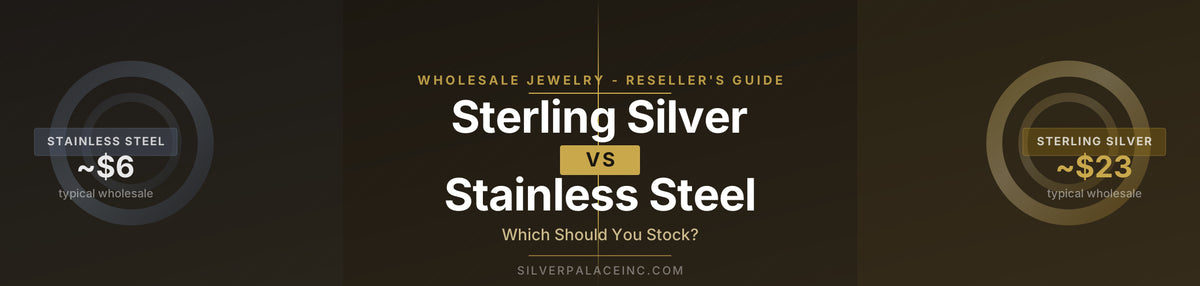
Sterling Silver vs Stainless Steel
Sterling Silver vs Stainless Steel: Which Should You Stock?
Real wholesale prices, durability facts, margin math, and where each metal sells best — from our LA Jewelry District showroom.
Key Takeaways
- Stainless steel jewelry wholesales for about $6 a piece, compared with about $23 for 925 sterling silver at Silver Palace (catalog prices as of November 6, 2026).
- A $200 order buys about 34 typical stainless pieces or about nine typical sterling pieces.
- Stainless steel resists tarnish and scratches. Sterling silver has real metal value, a brighter shine, and can be resized or repaired.
- Silver prices move with the metals market. Stainless steel prices don't, which makes stainless the steadier line to restock.
- You can't sell stainless steel as "silver." Under FTC guidelines, "silver" means at least 92.5% pure silver.
Sterling silver vs stainless steel comes down to value versus durability. Sterling silver is a precious metal (92.5% silver) that looks brighter, holds metal value, and can be resized, but it tarnishes and costs more. Stainless steel is harder, doesn't tarnish, and wholesales for a fraction of the price: about $6 a piece versus $23 for sterling at Silver Palace. Most resellers do best stocking both.
Here's the moment every reseller knows. A customer picks up two cross pendants that look almost the same: one is 925 sterling silver, the other is stainless steel.
"What's the difference? Is this one real silver? Will it turn green?" Your answer decides the sale, and whether that piece comes back as a return.
You already know your customers care about price and looks. What they rarely know is how differently these two metals wear, and how differently they pay you. We've been a direct importer in the LA Jewelry District since 1996, and we stock both lines. This sterling silver vs stainless steel guide covers real wholesale prices, what each metal does better, and where each one sells. It ends with the margin math on a $500 order.
Sterling Silver vs Stainless Steel at a Glance
Start with the quick comparison. These are the questions your customers ask most, answered side by side.
[STEEL GRADE] field below (iron alloy composition) needs to be confirmed with the supplier before publishing. Confirm whether the stainless line is 304 or 316L, and whether gold-tone pieces are PVD/IP or electroplated. Update the table row and the hypoallergenic section accordingly.| Factor | 925 Sterling Silver | Stainless Steel |
|---|---|---|
| What it is | 92.5% silver plus 7.5% other metals, usually copper | Iron alloyed with chromium and nickel [STEEL GRADE — confirm 304 vs 316L] |
| Hardness (Mohs) | About 2.5–3, scratches and bends more easily | About 5.5–6, much harder to scratch |
| Tarnish | Darkens over time, polishes back to bright | Doesn't tarnish |
| Water and sweat | Speeds up tarnish | Handles showers and sweat well |
| Weight in hand | Heavier (about 10.4 g/cm³) | Lighter (about 8 g/cm³) |
| Repair and resizing | Easy for most jewelers | Hard, needs special tools |
| Metal value | Yes, tied to the silver price | None as a precious metal |
| Typical wholesale price | About $23 | About $6 |
| Price stability | Moves with silver spot | Stable |
The short version: stainless steel wins on toughness and price. Sterling silver wins on value, shine, and repairability. Neither is "better" for every buyer, so the smart question isn't which metal is best. It's which metal fits each customer and each price point at your counter.
Stainless Steel vs Sterling Silver Wholesale Prices
Price is the biggest sterling silver vs stainless steel difference for your bottom line. We compared typical (median) wholesale prices across our full stainless steel line and a large sample of our sterling silver catalog. All prices are regular prices, not clearance, as of November 6, 2026.
| Category | Stainless Steel (typical) | 925 Sterling Silver (typical) | Sterling costs about |
|---|---|---|---|
| Earrings | $4.50 | $16.19 | 3.6x more |
| Pendants | $6.40 | $18.99 | 3x more |
| Chains | $3.50 | $20.61 | 5.9x more |
| Rings | $3.70 | $22.49 | 6.1x more |
| Bracelets | $6.90 | $33.75 | 4.9x more |
| All pieces | $5.90 | $23.10 | 3.9x more |
Most stainless pieces in our line fall between $2.90 and $9.50. Most sterling pieces fall between $7.70 and $80, depending on weight, stones, and plating. For a full breakdown of silver pricing, see our guide to how much wholesale silver jewelry costs.
Why sterling silver costs more
Sterling silver contains real silver, and that silver has a market price. Silver spot was $52.67 per troy ounce on November 6, 2026 (JM Bullion). At that price, sterling is worth about $1.57 per gram in silver alone. A heavy chain can hold $20 or more of metal before anyone pays for labor or finishing.
Stainless steel is an industrial metal. Its cost comes mostly from design, plating, and labor, not from a commodity market. That's why a stainless ring can wholesale for under $4.
Silver prices move. Stainless steel prices don't.
Silver hit a record $121.67 an ounce in January 2026, then fell more than half by November. Wholesale silver jewelry follows that market with a lag. For example, our basic 3.0mm Miami Cuban chain in 16" dropped from $37.73 to $33.80 — about 10% between late September and early November.
That's good news when silver falls. However, it makes your restock cost harder to predict. Stainless steel doesn't move with metal markets, so your cost on a reorder six months from now should look a lot like your cost today. If you sell on thin margins, that steadiness matters.
Durability, Tarnish, and Skin: What Your Customers Will Ask
Your customers won't ask about Mohs scales. They'll ask "Will it last?", "Can I shower in it?", and "Will it turn my skin green?" Here's how to answer each one honestly.
Which metal scratches and bends more?
Sterling silver scratches and bends more easily than stainless steel. Sterling rates about 2.5–3 on the Mohs hardness scale, while stainless steel rates about 5.5–6. That means stainless rings and chains hold their shape better with daily wear, and they show fewer fine scratches.
The trade-off is weight and feel. Sterling silver is denser, so a sterling piece feels heavier in the hand. Many buyers read that weight as quality, which helps sterling sell at a higher price.
Does sterling silver tarnish? Does stainless steel?
Yes, sterling silver tarnishes, and stainless steel doesn't. Sterling darkens over time because the copper and silver react with sulfur in the air, sweat, and lotions. A polishing cloth brings it right back. Stainless steel resists tarnish and rust because of its chromium content.
For you, tarnish is an inventory issue as well as a customer issue. Sterling stock needs anti-tarnish bags or strips, especially if it sits for months. Our guide on how to store jewelry inventory covers simple ways to keep silver bright on the shelf.
Can you shower with sterling silver or stainless steel?
Stainless steel handles showers and sweat well. Sterling silver can get wet without damage. However, water, soap, and chlorine speed up tarnish, so it's best to take sterling off before pools, hot tubs, and the beach.
One caution for both metals: plating wears faster than the metal underneath. Gold-plated or black-plated stainless steel and rhodium-plated sterling both last longer when customers avoid harsh chemicals. Tell your buyers that, and you'll get fewer "it changed color" complaints.
Is stainless steel hypoallergenic?
Stainless steel is generally well tolerated, and most buyers with sensitive skin wear it without problems. However, most stainless steel contains some nickel, a common skin allergen. In grade 316L, for example, nickel is 10–14% of the alloy, bound inside the metal (Cleveland-Cliffs 316/316L data sheet). A small number of very nickel-sensitive people still react.
Sterling silver is also usually fine for sensitive skin. Reactions to "silver" jewelry often come from nickel in cheap plated fashion pieces, not from real 925.
As for turning skin green: that's usually copper reacting with sweat, and it can happen with sterling because of its copper content. It's harmless and washes off. Quality stainless steel rarely does it.
Repair, resizing, and value over time
Sterling silver is easy for most jewelers to resize and repair, and it keeps real metal value. Stainless steel is much harder to resize, and most shops won't work on it. It has no scrap value either.
That's why sterling fits buyers who want a piece to last for years, like a wedding band, a family gift, or a religious medal. Stainless fits buyers who want low-maintenance, everyday wear at a low price.
Which Metal Sells Best Where
The best sterling silver vs stainless steel mix depends on who you sell to. Here's how the two metals usually line up by channel, based on what our resellers tell us at the showroom.
| Where you sell | Lean stainless steel | Lean sterling silver | Why |
|---|---|---|---|
| Swap meets and flea markets | Impulse pieces at $10–$20 | Chains and statement pieces behind the glass | Low price points move fast; sterling brings the bigger ticket |
| Men's and hip hop | Rings, pendants, everyday chains | Miami Cuban chains, heavier pieces | Men often want tough, low-care pieces; heavy sterling reads as quality |
| Religious jewelry | Crosses and saint pendants for everyday wear | Medals, rosaries, gifts for baptisms and communions | Gift buyers often want real silver |
| Boutiques and gift shops | Waterproof add-ons | Core collection, Italian styles | Boutique buyers expect precious metal |
| Online stores | Low-return basics | Bestsellers with clear care notes | Tarnish complaints show up in reviews |
Our own stainless line leans toward exactly these customers. Over half of it is pendants, mostly crosses and men's styles in rhodium, gold-tone, and black finishes. Browse our stainless steel pendants and our wholesale men's jewelry to see how the two metals work side by side.
Replace this box with a block quote from Alec Norendzayan (2–3 sentences). Suggested topics: what he saw at the showroom when silver spiked in January, how swap meet buyers changed their orders, or what customers complain about most with each metal. Format as:
<blockquote>"Quote text here."</blockquote><cite>— Alec Norendzayan, Silver Palace Inc.</cite>
Stock both: one table, two price points
Here's an example of how the mix works. Picture a swap meet vendor; call her Rosa. She stocks only sterling silver, and her cheapest piece is a $35 pendant. Shoppers browse, but many walk away because $35 is a big impulse buy.
How to label stainless steel honestly
You can't call stainless steel "silver." The FTC Jewelry Guides say it's unfair or deceptive to describe a product as silver unless it's at least 925/1000 pure silver (16 CFR Part 23). That rule protects your customers and your reputation.
Use clear labels instead:
- "Stainless steel" or "silver-tone stainless steel" for steel pieces
- "925 sterling silver" only for real sterling
- "Gold-plated stainless steel" or "gold-tone" for plated steel, never "gold"
- A steel grade like "316L" only when your supplier confirms it
Honest labels also cut returns. A customer who knows they bought stainless won't come back angry that it isn't silver.
Margin Math: Stainless Steel vs Sterling Silver on a $500 Order
So which metal makes you more money? It's closer than most resellers expect. Here's a simple example using our typical wholesale prices and a standard 2.5x to 3x markup.
| $500 Order | Pieces you get | Retail price each (2.5x–3x) | Gross profit if everything sells |
|---|---|---|---|
| All stainless steel | About 85 at $5.90 | About $15–$18 | About $750–$1,000 |
| All 925 sterling silver | About 21 at $23.10 | About $58–$69 | About $730–$970 |
The profit lands in a similar range either way. The difference is how you earn it:
- Stainless steel gives you more pieces to sell, a lower price point, and fewer tarnish complaints. It also takes more table space and more individual sales to reach the same profit.
- Sterling silver earns more profit per sale and holds metal value if it sits. It also needs anti-tarnish storage, and its cost moves with the silver market.
Many resellers round low-ticket stainless pieces up to easy price points like $10, $15, or $20. Round numbers make impulse buys easier and simplify cash sales at a booth.
Frequently Asked Questions
The Bottom Line on Sterling Silver vs Stainless Steel
The sterling silver vs stainless steel decision isn't either/or for most resellers. Stainless steel gives you tough, tarnish-free pieces at about $6 wholesale, perfect for impulse price points and everyday wear. Sterling silver gives you real metal value, a brighter shine, and bigger profit per sale. Together, they let you sell to the customer with $12 and the customer with $70 at the same table.
Price the two lines differently, label them honestly, and store your silver right. You'll make more sales and handle fewer returns.